

How Much Does It Cost To Set Up A Ready Mix Concrete Plant?
As a Chinese manufacturer with 12 years of experience in exporting concrete batching plants, I have handled over 300 overseas projects, ranging from small-scale rural projects in Southeast Asia to large-scale commercial concrete production bases in the Middle East. "The cost to set up a ready mix concrete plant" is a core concern for every overseas client. Unlike the fixed prices of standardized products, the total investment cost of a ready mix concrete batching plant is affected by production capacity, automation level, environmental requirements, and local construction conditions, exhibiting a dynamic range from $80,000 to $800,000.
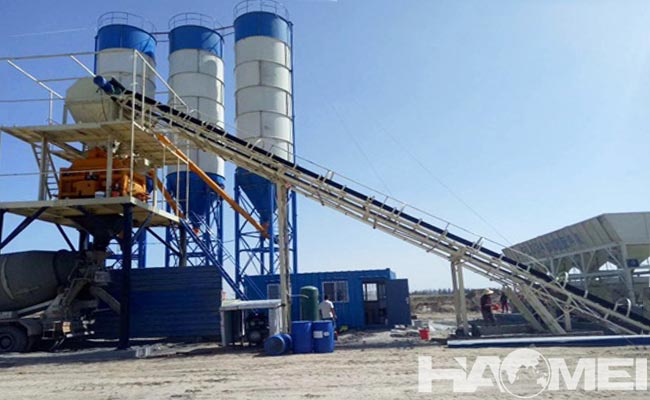
I. Core Costs: Equipment Investment (50%-70% of total investment, determining production capacity and stability)
Equipment is the core component of the ready mix concrete plant, accounting for the highest cost proportion and directly determining the plant's production capacity and operational stability. Based on overseas market demands, we categorize equipment configurations into three tiers. Cost differences stem from upgrades to core components, rather than simply increased scale:
1. Small-scale ready mix concrete plant (25-50 m³/h):
Emphasizing simplicity and practicality, suitable for rural construction and small-scale contractor scenarios. Features a twin-shaft forced-action main unit, 2-3 100-ton cement silos, and a basic control system. Price: $80,000-$150,000.
2. Medium-scale ready mix concrete plant (60-120 m³/h):
The mainstream choice in overseas markets, suitable for urban residential and medium-sized infrastructure projects. Main unit power is upgraded to 75-110 kW, paired with a 4-silo batching machine and a semi-automatic control system. Cost: $180,000-$350,000.
3. Large-scale ready mix concrete plant (150-240 m³/h):
Designed for large-scale infrastructure projects, employing a dual-unit parallel structure, a fully automatic control system, and enclosed environmental protection features. Cost: $400,000-$650,000.
Practical Tip: Equipment configuration should have a 10%-15% redundancy to avoid secondary investment due to insufficient capacity later. An Indonesian client once wanted to "save costs" by choosing low-capacity equipment; we recommended upgrading the configuration. Although it involved an additional investment of $35,000, it increased capacity by 20% and shortened the payback period by 8 months.
II. Ancillary Costs: Civil Engineering and Installation (15%-30% of total investment, a key expenditure easily underestimated)
Civil engineering and installation directly affect equipment lifespan and operational safety. Due to differences in overseas geology and labor costs, costs fluctuate significantly and mainly include three parts:
1. Site Preparation:
Leveling, hardening, and drainage systems. Foundation costs: $12,000-$45,000; for soft soil foundations, an additional $8,000-$20,000 is required for reinforcement.
2. Foundation Construction:
Foundation pouring for core equipment such as the main unit and powder silos, requiring strict precision control (deviation ≤5mm). Cost: $18,000-$50,000.
3. Installation and Commissioning:
Cost is 8%-12% of the total equipment price ($14,000-$78,000). It is recommended to prioritize installation by the original manufacturer's team—a previous case involved an African customer who hired a local team for installation, resulting in equipment failure due to connection errors, with rectification costs far exceeding the savings from installation.
Optimization Tips: In regions with low labor costs, a "Chinese technical guidance + local labor construction" model can be adopted, saving 30%-40% of installation costs, provided that technical training is completed in advance.
III. Necessary Costs: Supporting Facilities and Compliance (10%-20% of total investment, determining legal operation)
This part is a prerequisite for the legal operation and environmental compliance of the concrete mixing plant, belonging to the "hidden essential needs." Cost differences mainly stem from differences in standards across different overseas regions:
1. Environmental Protection System:
Southeast Asian market requirements are lenient; dust collection ($5,000-$25,000) and wastewater recycling ($8,000-$30,000) are sufficient to meet standards. European and American markets require an additional investment of $20,000-$40,000 for advanced filtration systems.
2. Auxiliary Equipment:
Loaders ($30,000-$80,000), concrete transport trucks ($45,000-$120,000/unit), laboratory equipment ($10,000-$35,000). 1-3 transport trucks based on production capacity are sufficient for initial needs.
3. Licensing and Certification:
Environmental permits, business licenses, and product quality certifications total $6,000-$30,000. Certification fees in the Middle East are 2-3 times higher than in Southeast Asia.
Practical Experience: Communicating with local governments about environmental standards in advance can avoid later rectification costs. Our customized environmental system for a Saudi client successfully passed acceptance testing because it was adapted to local standards beforehand, saving $18,000 in rectification costs.
IV. Hidden Costs: Working Capital (5%-10% of total investment, ensuring smooth commissioning)
This cost segment is relatively small, but directly determines whether the mixing plant can be successfully commissioned and operate stably. It mainly includes:
1. Raw Material Reserves:
Initial inventory of cement, aggregates, admixtures, etc., requiring $20,000-$50,000 to ensure continuous production in the initial stage;
2. Personnel Training:
Training for operators, maintenance personnel, and managers, costing $5,000-$15,000. A skilled team can improve production efficiency by 30% and reduce the failure rate by 20%;
3. Spare Parts Inventory:
3%-5% ($2,400-$32,500) of the total equipment price should be reserved for wear parts (mixing arms, liners, etc.) to avoid production stoppages due to spare parts shortages.
V. Practical Cost Optimization and Total Investment Reference
Based on global project experience, the total investment and payback period for different scenarios can be accurately referenced. The core optimization idea is "adapting to needs, rather than simply saving money":
1. Scenario-based Total Investment:
Small station (rural construction): $120,000-$220,000, payback period 12-18 months; Medium station (urban infrastructure): $280,000-$480,000, payback period 8-12 months; Large station (large-scale infrastructure): $550,000-$800,000, payback period 6-8 months;
2. Cost optimization techniques:
First, select equipment according to needs. For example, a Vietnamese client planned to purchase a large-scale plant, but we recommended a medium-sized plant based on their market requirements, directly saving $120,000. Second, phased investment: initially build the core production line, and later upgrade environmental protection and automation modules as needed, reducing initial investment by 30%. Third, local procurement: sourcing non-core components (such as aggregate bins and control rooms) locally can save 15%-20% in costs.
Precise calculation for optimal return on investment. The cost to set up a ready mix concrete plant needs to be precisely calculated around four core areas: equipment, civil engineering, supporting facilities, and operation. The core is "adapting to local needs"—avoiding both the waste of resources caused by over-engineering and the secondary investment resulting from adapting small-scale production to large-scale projects. As a Chinese exporter, we can provide a one-stop solution from equipment selection to installation and commissioning, helping overseas clients accurately control costs, build efficient and compliant batching plants with reasonable investment, and achieve long-term stable returns.

Inquiry
| (Please write down the product model or any requirement) | |
| E-mail: | |
| Message: | |
Contact Information
E-mail:chris@concretebatchplant24.com
Tel: +86-371-65621392
Fax:+86-371-86616825
Add : No.14 Waihuan Road,New strict,Zhengzhou,China